
Universal Nanovial Screening Enables Functional Discovery of Metabolite-Reactive T‑Cell Receptors for Cancer Therapy
Citradewi Soemardy, Yan-Ruide Li, Yichen Zhu, Xinyuan Shen, Lili Yang, Dino Di Carlo
ACS Nano, April 2026
https://doi.org/10.1021/acsnano.5c22721
Preprint: https://www.biorxiv.org/content/10.1101/2025.08.06.668816v2
Abstract
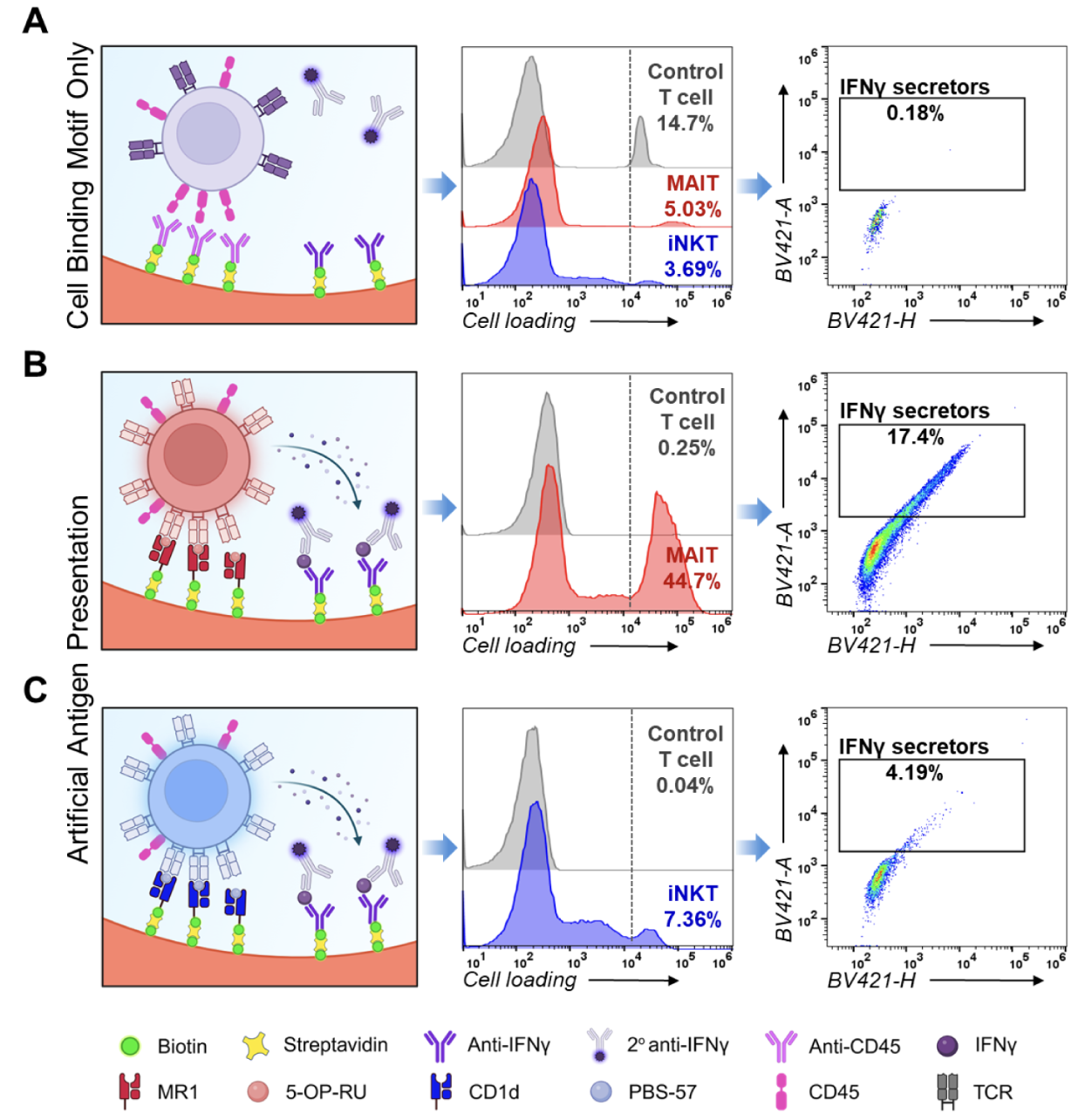
Unconventional T cells, including mucosal-associated invariant T (MAIT) cells and invariant natural killer T (iNKT) cells, recognize nonpeptide antigens presented by MR1 and CD1d, respectively, and offer unique therapeutic potential. Despite invariant TCRα chains, diversity in TCRβ regions may underlie unique sequence-to-function relationships. Here, we develop a nanovial-based functional screening platform for the high-throughput discovery of TCRs from unconventional T cells present in human blood. By labeling nanovials with MR1 or CD1d molecules and cytokine-capture antibodies, we enable antigen-specific capture, activation, cytokine secretion, and oligobarcode-linked identification. Using secretion-encoded single-cell sequencing, we isolate rare MAIT and iNKT cells and associate their TCR identities with functional phenotypes. All five MAIT TCRs conferred antigen-specific cytokine secretion and cytotoxicity in vitro, with the two tested in vivo demonstrating tumor targeting, intratumoral accumulation, and measurable antitumor activity. Our nanotechnology-enabled “function-first” screen unlocks precision TCR discovery for unconventional T cells and supports the development of therapies targeting aberrant metabolic pathways.
Topics
TCR Discovery, Cell Therapy, Functional Cell Screening
Cell Types
Mucosal-associated invariant T (MAIT) cells, invariant natural killer T (iNKT) cells
Secretion Targets
IFN-γ