
Mapping and engineering the human cell–cell interactome
Dino Di Carlo, Leonardo Morsut, Megan L. McCain, Heather J. Wright, Mohamad Abedi, Sean A. Yamada-Hunter, Jason Z. Zhang, Keriann Backus, Eunji Chung, Yingxiao Wang, Thomas A. Rando, Long Cai, Matt Thomson, Michael B. Elowitz, John K. Lee & Owen Witte
Nature Biotechnology, June 2026
Abstract
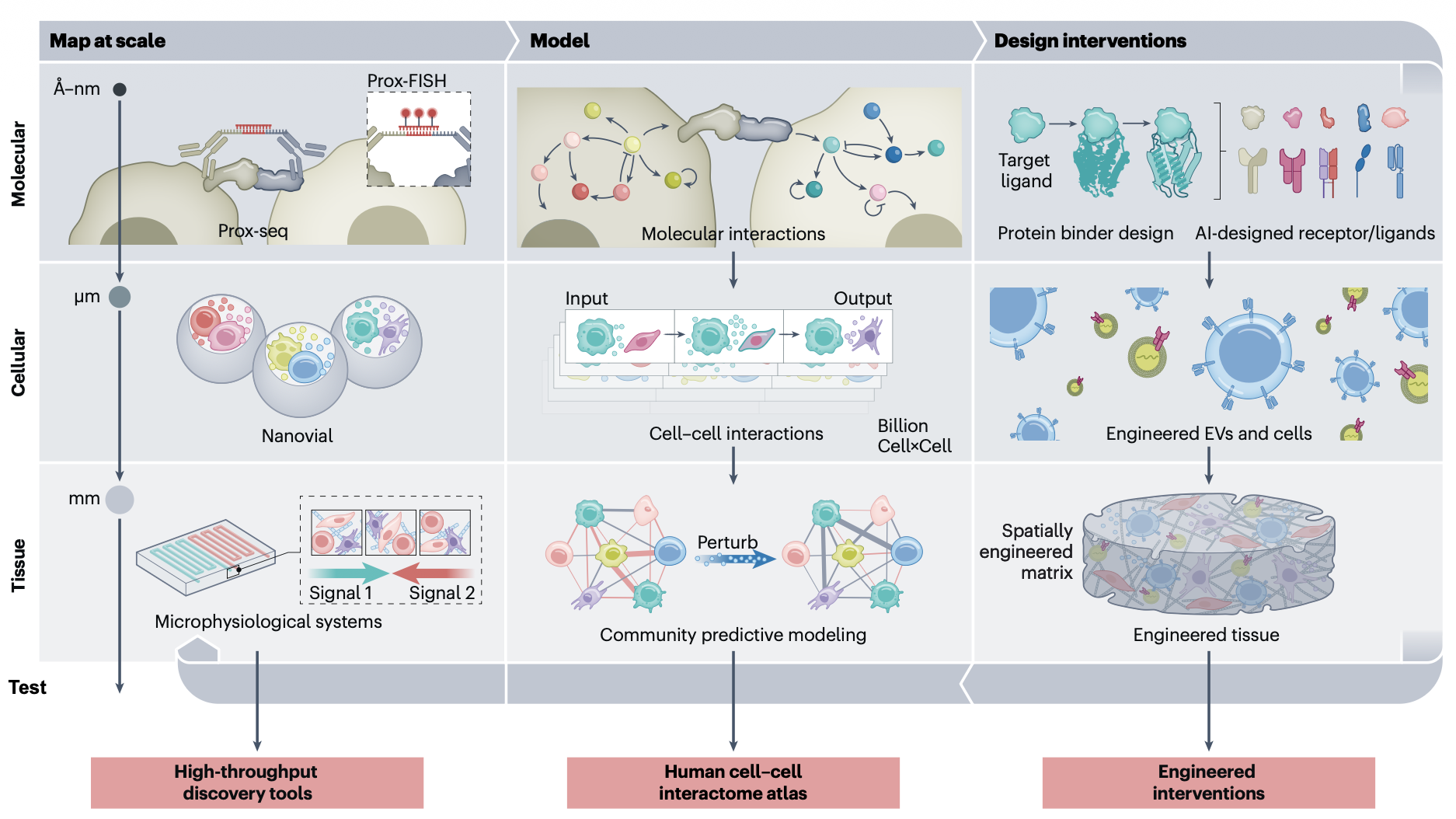
Efforts to systematically understand how cell interactions tune tissue-level function have motivated transformative advances in single-cell transcriptomics and spatial profiling. Although these technologies can measure molecular states in individual cells and their spatial mapping within tissues, they also reveal that there exists a fundamental knowledge gap of how cells influence each other in context. In this Perspective, we propose an initiative to map and engineer the human cell–cell interactome: a functional atlas of how all major human cell types communicate. We highlight how recent innovations can make this vision achievable. As a first moonshot, we propose the ‘Billion Cell×Cell Project’, which systematically characterizes the outcomes of defined cell–cell dyads across diverse cell types and conditions. We envision this multistage initiative will produce progressively deeper insights and unlock additional avenues for therapeutic discovery. We call on the scientific community to join us in building the tools, datasets and models that will decode and rewrite the language of life between cells.
Topics
Technology, Cell-Cell Seq, Review