
Functionalizing Hydrogel Nanovials with Vesicles Mimicking Antigen-Presenting Vesicles and Cancer Exosomes Improves T Cell Capture and Activation.
Blade A. Olson, Michael Mellody, Citradewi Soemardy, Zhiyuan Mao, Anna Mei, Katie Lippert, Magnus A. G. Hoffmann, Dino Di Carlo, Stephen L. Mayo
ACS Nano, July 2026
Abstract
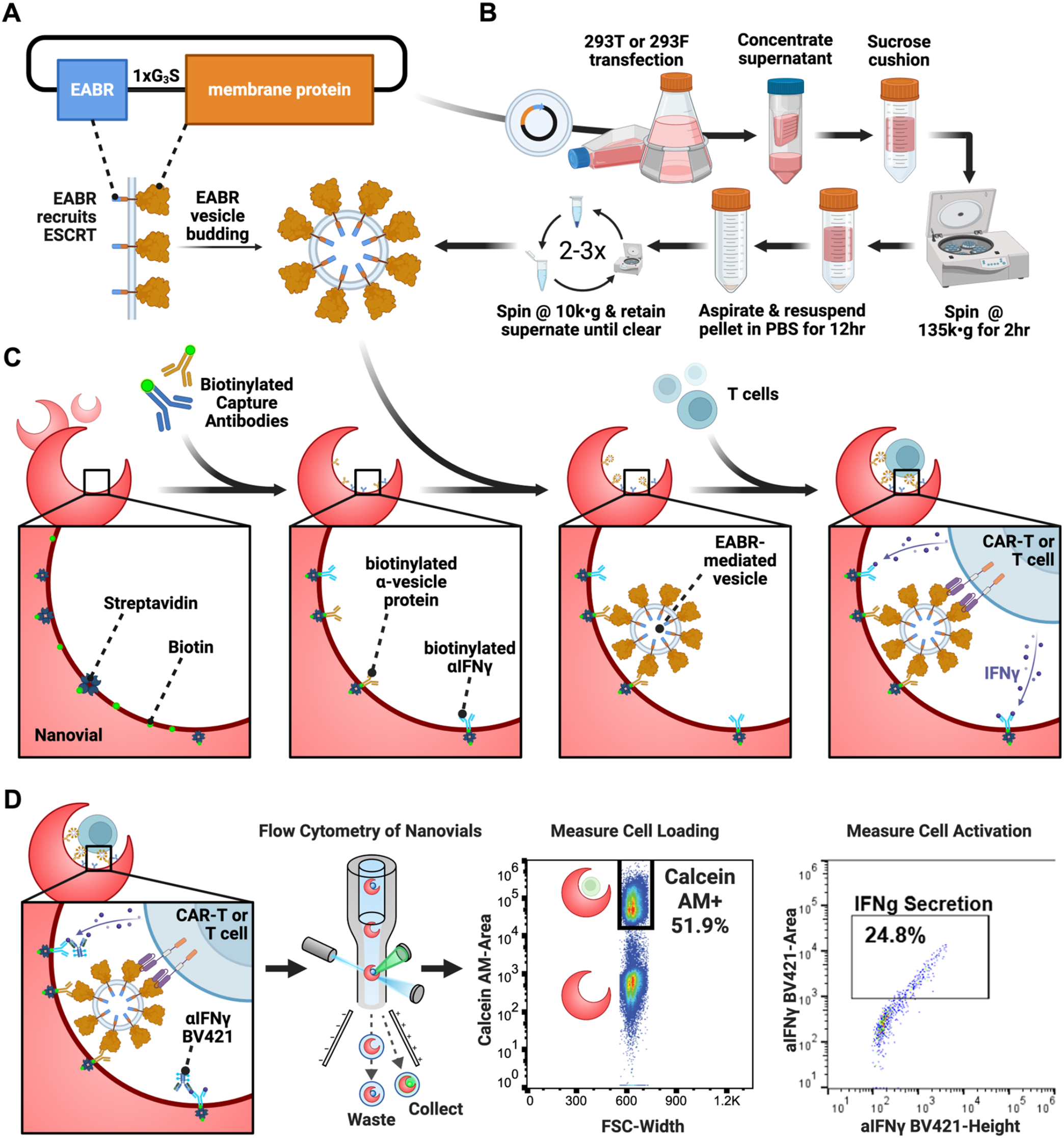
Recent advances have demonstrated the application of microcavity-containing hydrogel microparticles, known as nanovials, for massively parallel and high-throughput screening of therapeutic T cell populations for adoptive cell therapies. Nanovial cavities coated with peptide-MHC (pMHC) or antigen tetramers selectively bind to their cognate T cell receptor (TCR) or chimeric antigen receptor (CAR) to activate T cells and capture secreted cytokines. However, binding of tetramers or recombinantly expressed antigen by T cells may not reflect physiological T cell activation or cytotoxicity, as the binding interface is not fully representative of the natural immunological synapse formed between T cells and professional antigen-presenting cells (APCs). Here, we leverage the recent discovery of an ESCRT- and ALIX-binding region (EABR) sequence to generate antigen-presenting vesicles and cancer-mimicking exosomes from standard HEK293T and Expi293F cell cultures. EABR-mediated vesicles present natural, full-length oncologically relevant membrane proteins embedded in lipid bilayers to functionalize the nanovial cavity with cell-like membranes. Hydrogel nanovials functionalized with the EABR-mediated vesicles show improved T cell capture of 1G4 T cells and enhanced induction of secretion in HER2 CAR-T cells compared to hydrogel surfaces functionalized with recombinantly expressed soluble proteins.
Topics
Extracellular Vesicles, Cell Therapy, Functional Cell Screening, Workflow Improvement
Cell Types
Human T cells, Human CAR-T cells
Secretion Targets
IFN-γ