
Cell-Cell-Seq resolves contact-associated NK cell activation in defined tumor cell dyads
Jesse Liang, Devon Shao, Dino Di Carlo, Joseph de Rutte
bioRxiv, June 2026, In Press
Abstract
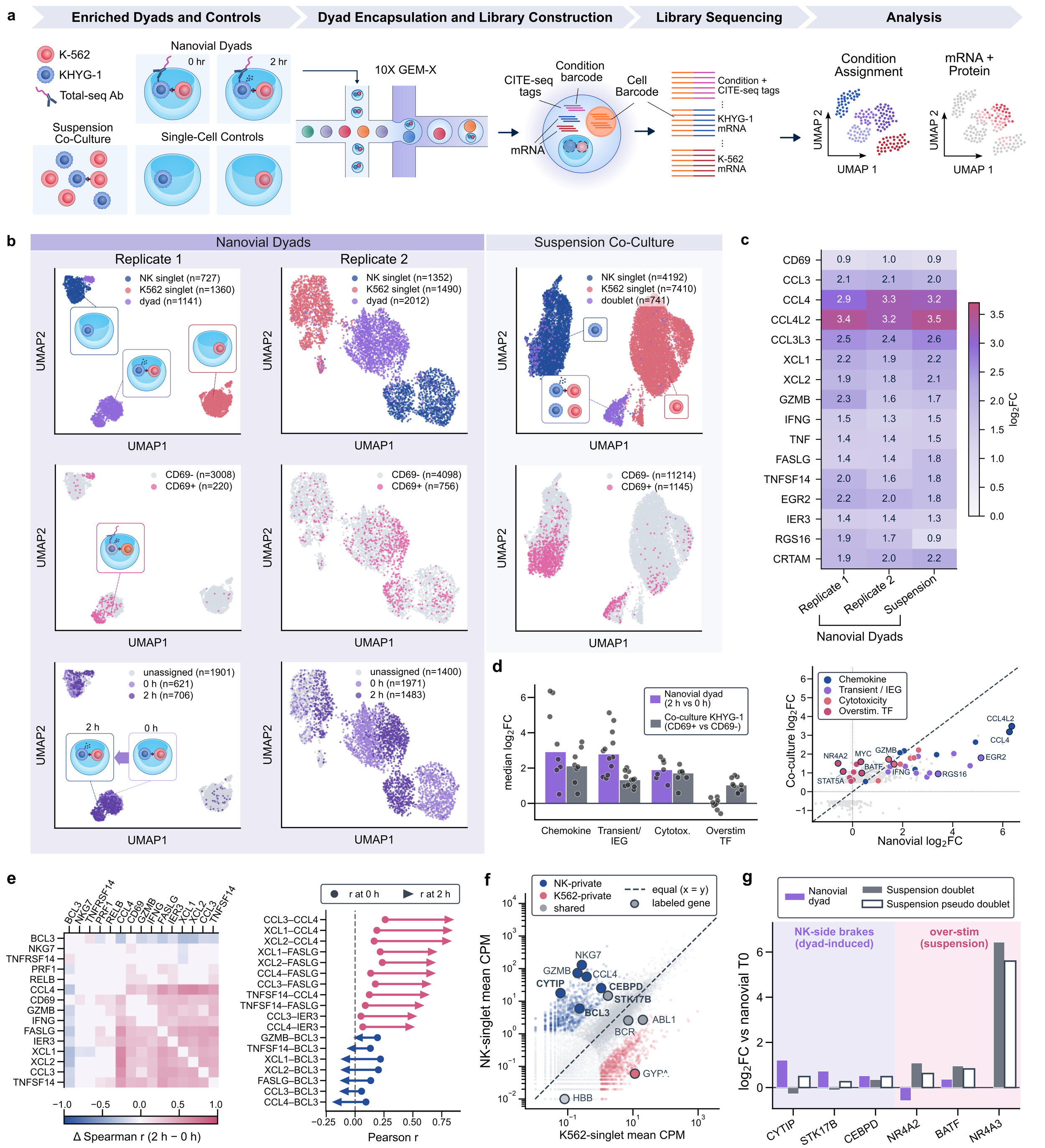
Cell-cell interactions shape immune recognition, but most single-cell transcriptomic methods measure cells after their interaction history has been lost or inferred. Here we apply Cell-Cell-Seq, a Nanovial-based workflow for sequencing defined cell pairs, to resolve contact-associated activation of natural killer cells paired with leukemia targets. Nanovials enabled controlled dyad formation, incubation, flow enrichment and droplet-based sequencing while reducing uncontrolled partner exchange and aggregation seen in suspension co-culture. Cell-Cell-Seq recovered a reproducible activation program marked by chemokine, cytokine, cytotoxic and immediate-early response genes. Compared with randomly mixed suspension co-culture, defined dyads emphasized contact-proximal activation, whereas suspension co-culture showed stronger features of early overstimulation. Dyad-resolved measurements also benchmarked computational models of cell-cell communication, identifying inferred signalling axes that were recovered and contact-induced programs missed by current approaches. These results establish Cell-Cell-Seq as a scalable strategy for mapping how defined immune-tumour encounters reshape cell state.
Topics
Workflow Improvement, Technology, Cell-Cell Seq