
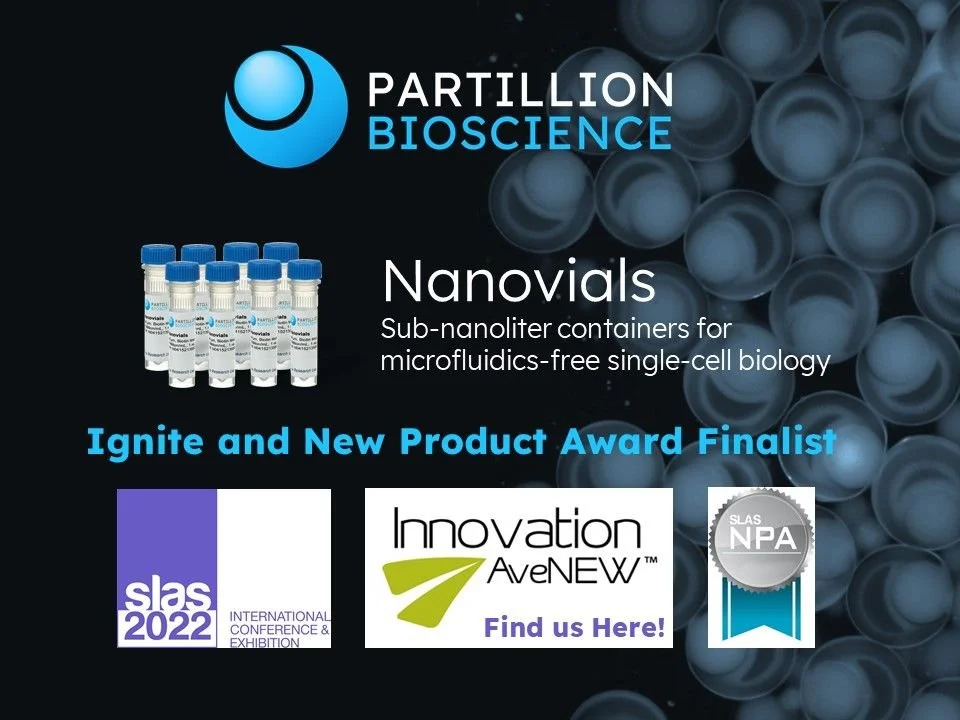
Partillion Bioscience has been nominated for multiple awards at the upcoming Society for Laboratory Automation and Screening annual meeting. The SLAS annual meeting is the premier conference for lab automation and drug screening.
We were selected as a top 5 finalist for the Ignite Award for promising new and emerging companies. Additionally, our Nanovial product was selected as a top finalist for the best New Product Award.
We will be exhibiting our products at the Innovation AveNEW as part of the meeting in Boston starting February 7th. Please stop by if you will be attending the event and follow us on LinkedIn to be kept updated on our Nanovial products and when they become available for purchase.
About Partillion Bioscience
Partillion Bioscience is venture-backed life science company developing a next generation single-cell analysis platform. Our award winning nanovial technology enables our customers to accelerate therapeutic development to address the most difficult diseases and provide advanced scientific insights. Our reagent-based platform unlocks the ability to screen hundreds of thousands to millions of individual cells based on critical yet difficult to probe functional information all while using common lab equipment.
Featured Articles
Partillion's Nanovial technology will support a $2.5M CIRM-funded, USC-led study investigating why some CAR T cells respond effectively to their targets while others fail. The research will use Cell-Cell-seq to explore individual cell-cell interactions and their role in CAR T cell potency.
How are cell-cell interactions measured? Compare single-cell RNA-seq, ligand-receptor inference, spatial biology, imaging, co-culture, and functional cell-cell interaction assays to understand what each method measures, its strengths, and its limitations.
A bioengineer’s reflection on the Human Cell Atlas. Why understanding predictive tissue biology requires a new measurement layer for cell-cell interactions.

Why are single-cell foundation models plateauing despite massive scaling? The bottleneck isn't scale—it’s signal. Discover how interaction-resolved datasets are bridging the data gap for predictive biology and virtual cell models.

At the 2026 Cell-Cell Symposium, researchers across disciplines converged on a new biological framework: understanding not just which cells are present, but what cells are doing to each other. From spatial context to causal mechanisms, the meeting made clear that the future of biology lies in decoding cell-cell interactions.

Thousands of scientists and clinicians descended on Chicago this May with the goal of advancing the field of immunology through the exchange of ideas and information with their fellow scientists. Part of the mission of the AAI is the study of immunology in the pursuit of improving therapies for human disease. This is a brief synopsis on the trends presented at Immunology 2024.

Financing will fund growth and expansion of new functional single-cell analysis and sorting product lines for drug discovery, enabled by Partillion's proprietary Nanovial technology.
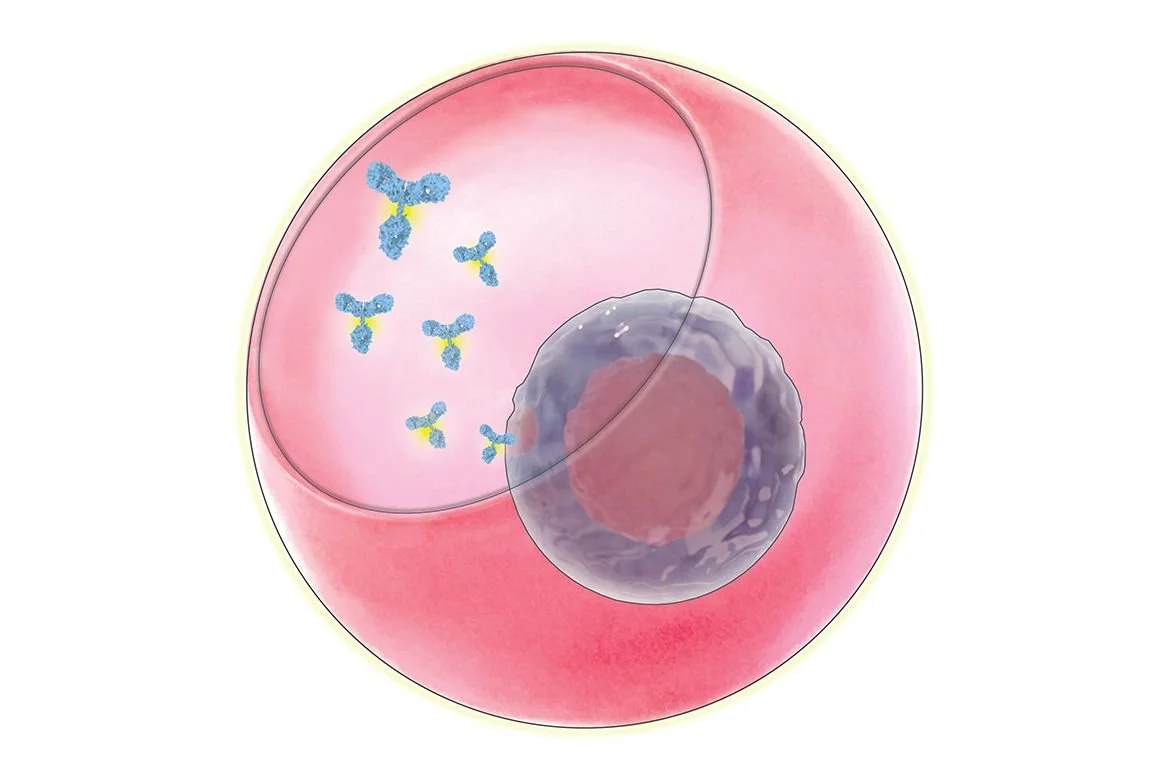

In an interview with Genetic Engineering & Biotechnology News Partillion Bioscience Co-Founder and Prof of Bioengineering at UCLA, Dino Di Carlo highlights how single-cell tools such as our nanovial technology play a critical role in improving cell therapies by enabling functional screening of cells.
In a collaboration between Partillion Bioscience and Richard James Lab at Seattle Children’s Hospital, researchers explore the link between B cell secretion of IgG, surface markers, and gene expression for thousands of single cells for the first time.