
What Comes After Mapping Every Cell?
A bioengineer’s reflection on the Human Cell Atlas, predictive biology, and why interactions may be the next missing layer
July 16, 2026
A First-Time View of HCA
I landed in Boston during the World Cup, which made the global nature of the meeting feel a bit more tangible. Outside the conference, people were walking through the city in jerseys and gathering around TVs to catch games. Inside the meeting, a different global effort was underway, with scientists from around the world coming together for the 10th anniversary of the Human Cell Atlas.
This was my first HCA meeting, and I came in with a bioengineering lens. I tend to think about biology through the question of measurement: what can we control, what can we observe directly, and what are we still inferring because we do not yet have a better way to measure it. At Partillion, that often means thinking about how to hold cells, sort cells, capture secretions, control interactions, and connect those measurements back to specific biological questions. That perspective shaped how I listened to the meeting.
From Maps to Journeys
HCA is now ten years in, and the scale of what the community has built is impressive: reference maps of human cells across tissues, technologies, countries, and disciplines. There were clearly major milestones to celebrate. At the same time, the meeting did not feel like a victory lap. It felt more like a community taking stock of what has been built, while also recognizing how much of the journey is still ahead.
One line from the meeting stayed with me: “maps enable journeys.” That felt like a good description of where HCA is now. The first decade helped build a shared map of cellular identity. The next question is what kinds of journeys that map now makes possible.
For me, one of the most interesting journeys is from description toward prediction. That showed up in discussions of spatial organization, disease cohorts, longitudinal data, genetic background, environmental exposure, and multimodal measurements. The point was not just “more cells,” although scale still matters. The point was that biology needs context.
Why Foundation Models Need Better Biological Measurements
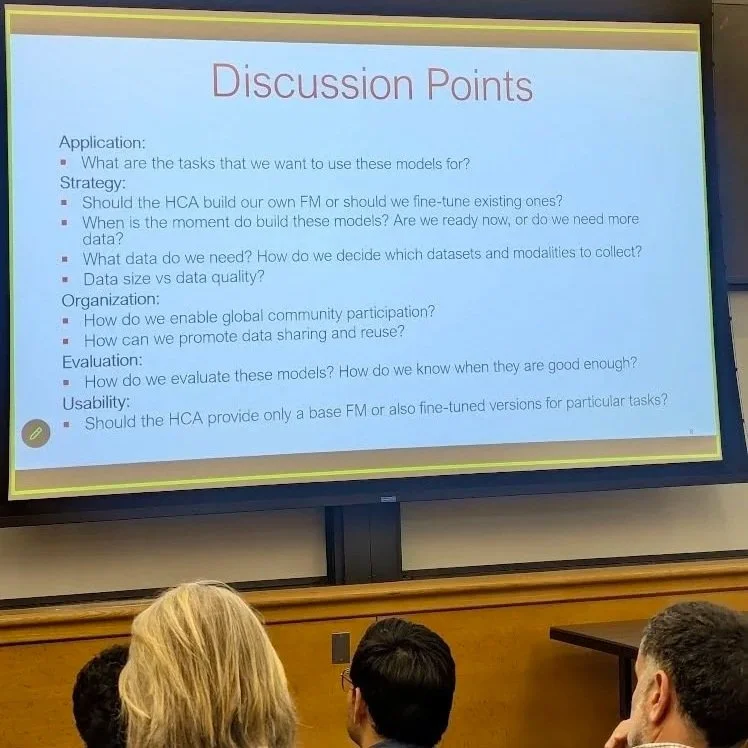
The foundation model discussions brought this into focus for me. There was clearly a lot of excitement around AI, but the conversations I heard were also practical and appropriately skeptical. What should these models actually do? How do we know if they are useful? Are we building models that can predict biology, or mostly models that help organize the data we already have?
One comment captured the mood well: improving biological models is “not just architecture improvements” and “not just more parameters.” I think that is an important point. More cells and larger models do not automatically mean better biological prediction.
The question I kept coming back to was whether models can help tell us what data we are missing. Where is the uncertainty? What measurement would change the answer? What experiment would make the model less wrong?
For me, that quickly turns into an experimental question.
Sometimes the Perturbation Is Another Cell
Single-cell atlases made individual cells visible at scale. Spatial biology added where cells are and how tissues are organized. Multimodal approaches add more information about the same biological system. But tissues are not just collections of cells. They are cells acting on each other.
A T cell recognizes a tumor cell. An antigen-presenting cell activates a T cell. A stromal cell suppresses an immune response. A therapy works, or fails, because it changes one of these interactions.
A point my co-founder Dino made that has stuck with me is that one of the most natural perturbations for a cell is not always knocking out a gene or adding a drug. Sometimes it is introducing another cell. That idea has shaped how I think about cell-cell interactions, and it came back to mind during the HCA discussions around perturbation and prediction.
“One of the most natural perturbations for a cell is sometimes introducing another cell.”
That is not how perturbation is usually framed. We often think about perturbations as gene edits, ligands, drugs, doses, or culture conditions. Those are all important. But in tissue, a neighboring cell can be the most important input. It has its own state, its own history, and its own response to the interaction.
If we want models that can predict tissue behavior, then maybe we need more data where the thing being measured is not only an individual cell state, but a defined interaction between cells.
This is not a criticism of atlas or spatial approaches. HCA gives the field a shared reference for cellular identity. Spatial biology gives us tissue organization and neighborhood context. But proximity and interaction are not the same thing.
Much of cell-cell interaction biology is still inferred from ligand-receptor expression, spatial proximity, or population-level changes after cells are mixed together. Those approaches are useful, but they do not always tell us what happened when one defined cell encountered another defined cell under a controlled condition.
From a bioengineering perspective, that raises a practical question: can the interacting pair become a unit of measurement?
A Measurement Layer for Interactions
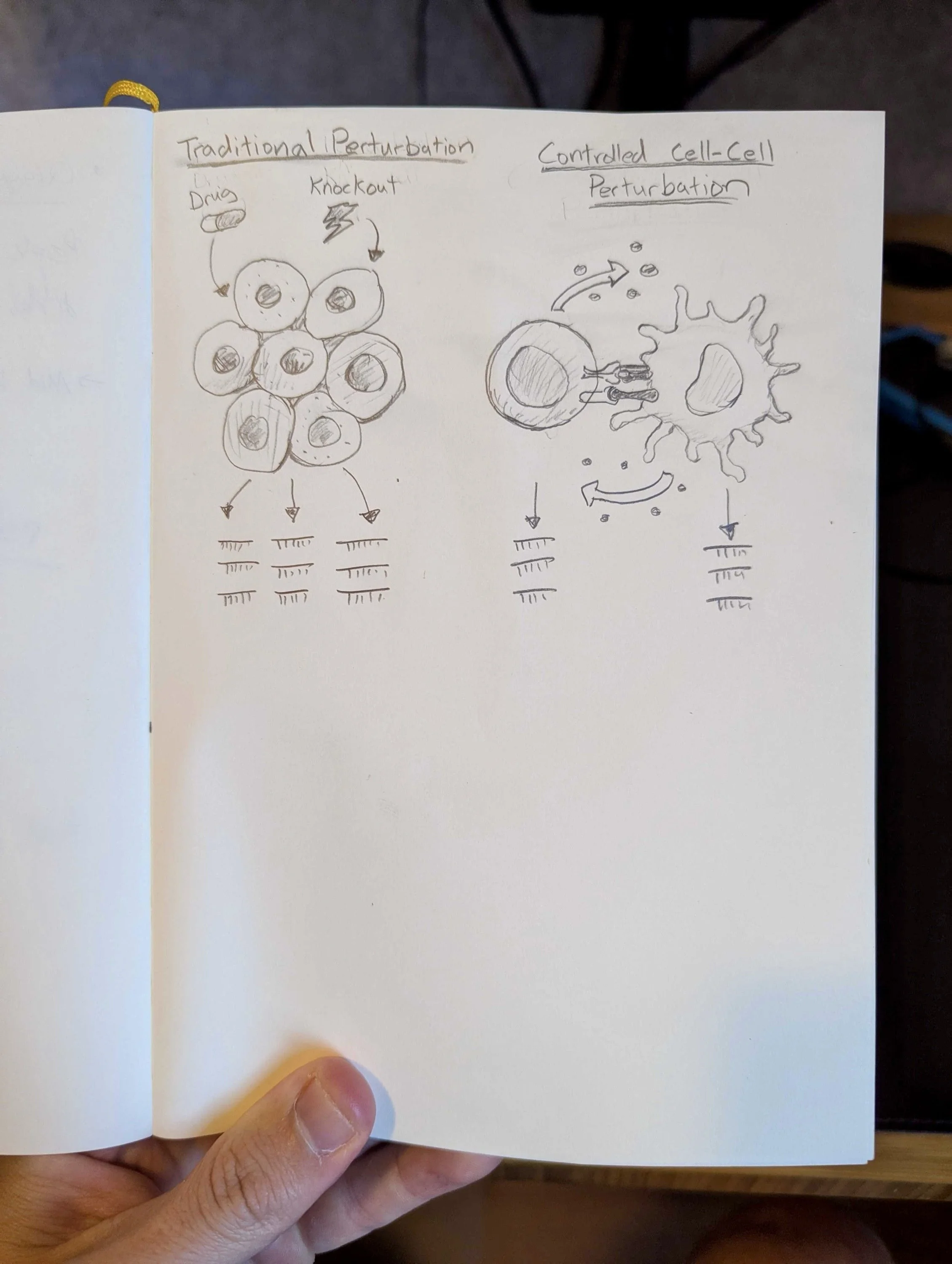
This is where the meeting connected back to my own work. At Partillion, we spend a lot of time thinking about how to make difficult cellular measurements more accessible. For cell-cell interactions, that means asking a fairly practical set of questions: can we bring defined cells together, control the interaction window, preserve the pair, and connect that interaction to downstream readouts?
That is the measurement problem behind Nanovial-based Cell-Cell-Seq. The goal is not to replace atlas or spatial approaches. It is to add another layer of information for biology that is often inferred but not directly observed: what happens when one defined cell encounters another defined cell?
I left HCA thinking that this type of interaction data may become increasingly important as the field moves from cellular maps toward predictive tissue models. If a virtual cell is meant to predict how a cell behaves in tissue, it probably needs examples of cells responding to other cells, not just measurements of cells in isolation.
That is not the whole future of HCA, and it is not the only missing layer. But for me, as a bioengineer, it is one of the measurements that could help make the cellular map more dynamic.